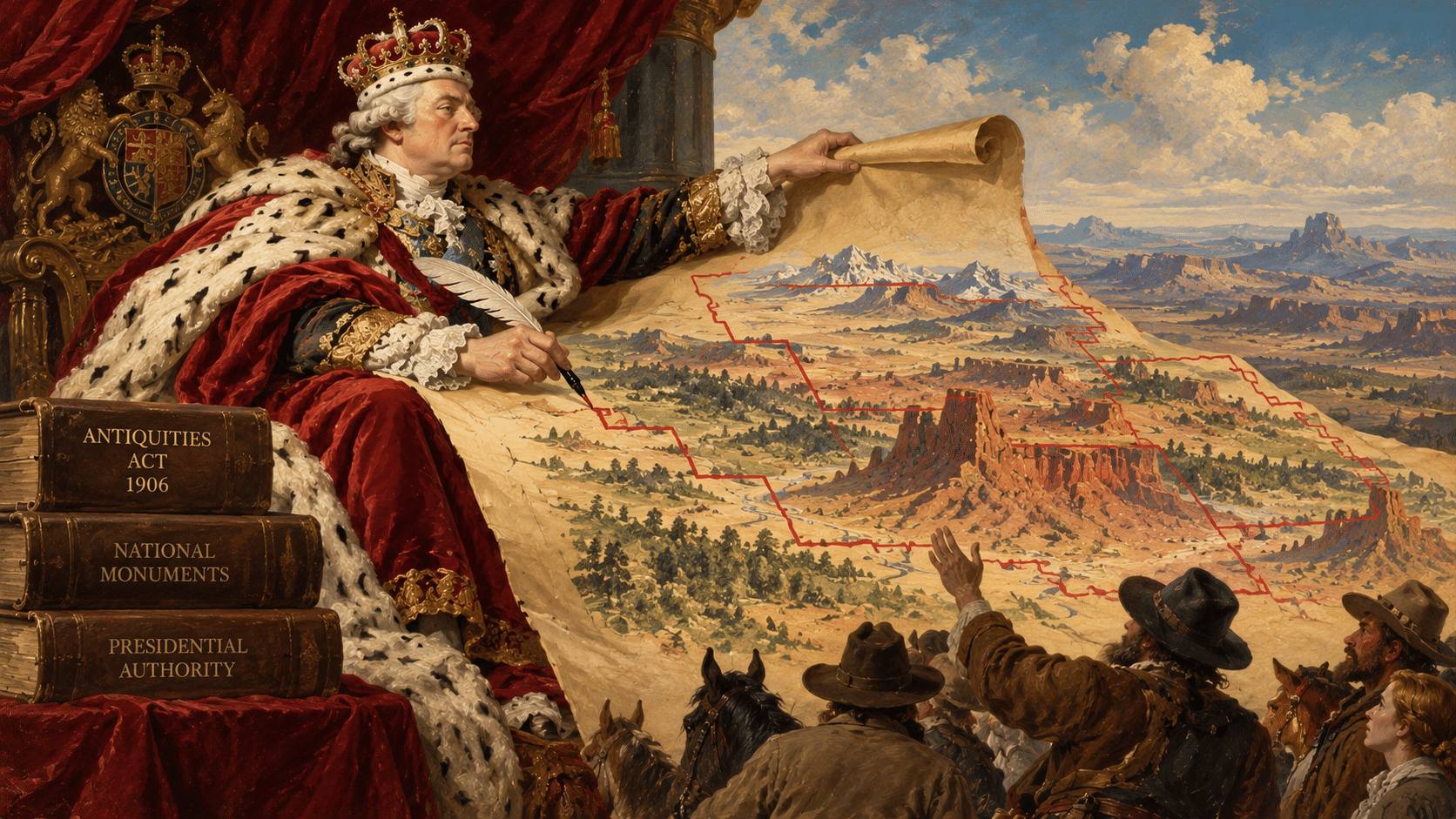
The Antiquities Act of 1906 lets the president proclaim national monuments on federal land. Presidents of both parties have used it since. The framers fought a war to escape a government that could redraw the map by decree, then gave Congress, not the executive, the power to make rules for federal land. The Antiquities Act hands a version of that power to one person with a pen.
The law’s text sets two limits. It covers “historic landmarks, historic and prehistoric structures, and other objects of historic or scientific interest,” and the designation must be “confined to the smallest area compatible with the proper care and management of the objects to be protected.” Decades of debate have turned on three questions:
- What counts as an object?
- How large is “the smallest area compatible”?
- Can a president shrink a monument a predecessor created? The Act does not expressly authorize a president to abolish a monument, and no president has. No court has ruled on whether one could. Presidents have reduced monuments, though. Three of them diminished Mount Olympus National Monument after 1909.
Those questions have gone unanswered for a century because the answers have been left to whoever holds the pen. National monuments have been among the most controversial issues in the West for 30 years, since President Clinton stood at the Grand Canyon in Arizona and designated 1.8 million acres in Utah. Bears Ears followed in 2016, when President Obama designated about 1.35 million acres. When President Biden expanded it, his proclamation said the landscape itself is the object to be protected. A statute that protects “objects” now protects scenery, and no court or Congress signed off on that expansion.
Local communities have overwhelmingly opposed monuments. Local elected officials pass resolutions against them because designations undercut the multiple-use management that has sustained their economies for generations. Monuments put restrictions ahead of multiple use, and the result is a net loss of recreation, access, and industry. Millions of acres have been closed to motorized use, roads have been closed, and campsites have been removed. The people who live next to these lands get no vote, no hearing, and no appeal. Subjects of a crown would recognize the arrangement.
The Legislative Approval for National Designations Act, or LANDs Act (H.R. 10669), was introduced October 1, 2026 by Rep. Paul Gosar of Arizona. Its original cosponsors are Reps. Begich, Boebert, Crane, Hageman, Kennedy, and Stauber. It applies only to designations made after enactment and does not change any existing monument. It would:
- Narrow what a monument can protect. “Objects of historic or scientific interest” becomes “object or objects of antiquity,” defined as relics, artifacts, human remains, fossils (other than fossil fuels), and certain buildings that predate the bill. Natural geographic features, landscapes, ecosystems, and “values” are excluded.
- Cap size and spacing. New monuments could not exceed 640 acres or sit within 50 miles of another monument designated under the Act.
- Limit emergencies. A designation of any size is allowed only to prevent imminent and irreparable harm to specific objects of antiquity. It expires after one year, can be used on the same land only once, and cannot be followed by a permanent designation. Existing uses under current land management plans and valid existing rights stay in place. Generalized, speculative, or long-term ecological or climate concerns do not qualify.
- Protect non-federal interests. Non-federal land could not be placed inside a monument without the owner’s written consent, water rights could not be reserved by designation, and a designation could not be read to increase federal appropriations.
- Require Congress for large withdrawals. A separate section requires express congressional authorization before a federal agency carries out any withdrawal of more than 5,000 acres. Exceptions cover temporary land orders of five years or less and withdrawals the president determines are necessary for national security.
None of this is exotic. Under the Alaska National Interest Lands Conservation Act of 1980, withdrawals of more than 5,000 acres in Alaska require congressional approval, the same threshold the LANDs Act applies nationwide. A 1950 law requires an act of Congress to establish a monument in Wyoming. Congress also holds the constitutional authority to designate monuments, change their boundaries, and abolish them, and it has done all three. The Antiquities Act is the exception, a standing delegation that lets the executive do what the Constitution assigns to the legislature.
Congress can still designate large monuments under the LANDs Act. The difference is that a monument of that size would have to pass through the branch whose members answer to the people living next to it. Large designations are controversial, and controversy is exactly why Congress has let presidents take them over. A president can skip the hearings, the amendments, and the vote, and often does so to win favor with groups that oppose motorized and multiple-use access.
A decision about millions of acres of public land, managed for the benefit of the public, should not rest with one person. A country that rejected a king should not hand a king’s power to its presidents, whichever party holds the office.
To keep access open for all forms of recreation on public lands, contact your members of Congress below and tell them to support the LANDs Act.