
WEMO DEEP DIVE / PART 4
The Tortoise Excuse
The desert tortoise has become the single most powerful weapon in the fight to close public land trails in the Western Mojave. The argument sounds compelling on its surface: off-road vehicles kill tortoises, so trails must be closed to protect them. There is one problem with that argument. The government's own data destroys it.
0.07%
*Estimated* share of tortoise population labeled as OHV-related death, per year, across entire planning area.
2,200
Miles of public trails subjected to closure based on this estimate.
1M+
Acres of public land essentially closed based on this estimate.
THE GOVERNMENT'S OWN NUMBERS
8 Tortoises Per Year. Across 3.1 Million Acres.
The U.S. Fish and Wildlife Service issued a Biological Opinion for the West Mojave Route Network Project in 2019. In it, FWS estimated the total "take" of desert tortoises from casual OHV use across the entire 3.1 million acre WEMO planning area: approximately 8 adult desert tortoises per year.
That estimate was based on "professional judgment" from a 2007 amendment to a prior biological opinion. It was not based on a field study. It was a guess extrapolated from limited carcass recovery which were "likely" caused by OHV-related use.
FWS itself acknowledged the take of 8 tortoises "represents approximately 0.07 percent of the estimated number of large desert tortoises" in the Western Mojave Recovery Unit, and that the projected cumulative take of 40 tortoises through 2024 "represents approximately 0.46 percent of the estimated number of large desert tortoises within the conservation areas."
This is the entire basis for closing trails. Not hundreds of tortoises. Not dozens. Eight. Per year. Across 3.1 million acres. By the government's own math.
And it gets worse...
8
FWS-estimated OHV-related deaths per year, across the entire planning area.
0.07%
Of the estimated large tortoise population that 8 deaths represents.
2,200
Miles of public routes subject to closures based on this estimate.
Sources
U.S. Fish and Wildlife Service. (2019). Biological Opinion for the West Mojave Route Network Project. FWS Administrative Record 5406, 5355.
Center for Biological Diversity v. Culver, Case No. 3:21-cv-07171-SI, Order on Cross-Motions for Summary Judgment at 87, 98 (N.D. Cal. Oct. 22, 2024).
ESTIMATE VS. EVIDENCE
What They Actually Found: 5 Tortoises in 11 Years
The FWS estimate of 8 per year was already small. The actual monitoring results were smaller.
Between 2007 and 2018, BLM found a total of 5 desert tortoises that "likely died because of casual use on the route network" across the entire planning area. Five tortoises. In eleven years. That is 0.45 tortoises per year, against an estimate of 8.
5
Total tortoises BLM monitoring linked to OHV use, 2007–2018.
11 yrs
Length of the monitoring period that produced those 5 carcasses.
0.45/yr
Actual annual rate detected, against an estimated 8.
The government's response is that scavengers remove carcasses quickly and the network is too vast to monitor effectively. That under-detection counterargument is addressed in detail below. It does not save the case for closure.
Sources
U.S. Fish and Wildlife Service. (2019). Biological Opinion for the West Mojave Route Network Project. FWS Administrative Record 5405, 5411.
Center for Biological Diversity v. Culver, Case No. 3:21-cv-07171-SI, Order on Cross-Motions for Summary Judgment at 99-100 (N.D. Cal. Oct. 22, 2024).
IN THEIR OWN WORDS
"Most routes of travel are not used on such a frequent basis that they would inhibit movement or be likely to result in traffic-induced mortality."
FSEIS at AR 103703-103706, quoted in Court Order at 30
THE CONTEXT
Per Mile, Per Acre Reality
The raw numbers are small. The numbers in context are vanishingly small. The WEMO route network inventory totals approximately 16,000 miles. The selected alternative designates roughly 6,000 miles of motorized routes across a 3.1 million acre action area.
Here is what the government's own estimate of 8 deaths per year looks like when you put it against the actual scale of the network:
1 Tortoise OHV-Related Death per 750 Miles of Trail per Year
That's roughly the distance between Las Vegas and Portland. And that is the worst-case scenario, based on the agencies' own guesswork.
Based on actual monitoring data the rate would be roughly 1 tortoise per 13,200 miles per year. For perspective, that is the distance from Los Angeles, traveling west across the Pacific Ocean, all the way to the coast of Somalia, Africa.
When the agency closes thousands of miles of trail to address an assumed mortality rate of one tortoise per Portland-to-Vegas stretch per year, the proportionality of the remedy to the documented threat collapses on inspection.
Sources
U.S. Fish and Wildlife Service. (2019). Biological Opinion for the West Mojave Route Network Project. FWS Administrative Record 5411, 5521.
Allison, L. J., & McLuckie, A. M. (2018). Population trends in Mojave desert tortoises (Gopherus agassizii). Herpetological Conservation and Biology, 13(2), 433-452. AR 204954.
Center for Biological Diversity v. Culver, Case No. 3:21-cv-07171-SI, Order on Cross-Motions for Summary Judgment at 9, 30, 85 (Table 7), 99 (N.D. Cal. Oct. 22, 2024).
"But the Real Number Could Be Higher"
Even at 20x the Estimate, OHVs Are Not the Driver
It is true that the real numbers "could" be higher. FWS admitted that scavengers remove tortoise carcasses "soon after death" and that "the network is too large" to monitor reliably. So the actual number of OHV-related tortoise deaths could be higher than the 5 found in 11 years.
It does not matter. Here is why.
The desert tortoise population in the Western Mojave Recovery Unit declined from approximately 35,777 in 2004 to 17,644 in 2014 — a loss of roughly 18,133 animals over ten years, or about 1,800 per year on average. The observed annual decline rate was approximately 7.1%.
The FWS guesses 8 OHV-related deaths per year. Even if scavengers hide 90% of the actual kills and the real number is ten times higher, at 80 deaths per year, that would account for only 4.4% of the roughly 1,800 annual losses. Multiply the FWS estimate by twenty and assume 160 deaths per year. That is still less than 9% of total annual mortality.
There is no reasonable multiplier that makes OHV use a primary driver of the population collapse. Where's the other 99%+ coming from? Read on to find out...
Sources
U.S. Fish and Wildlife Service. (2019). Biological Opinion for the West Mojave Route Network Project. FWS Administrative Record 5411, 5521.
Allison, L. J., & McLuckie, A. M. (2018). Population trends in Mojave desert tortoises (Gopherus agassizii). Herpetological Conservation and Biology, 13(2), 433-452. AR 204954.
Center for Biological Diversity v. Culver, Case No. 3:21-cv-07171-SI, Order on Cross-Motions for Summary Judgment at 9, 30, 85 (Table 7), 99 (N.D. Cal. Oct. 22, 2024).
INCONVENIENT TRUTH
Paved Highways Kill More Tortoises Than the Entire OHV Network
The 2019 BiOp itself cited a study noting that as many as 10 desert tortoises are reported killed annually on paved roads within Mojave National Preserve. The Mojave National Preserve is a fraction of the WEMO planning area.
Annual Desert Tortoise Mortality, Compared
Each bar reflects deaths per year. Drawn from the Court Order, FWS Biological Opinion, and Allison & McLuckie (2018).
Read that carefully: paved highways in a single preserve kill more tortoises every year than FWS estimates the entire OHV trail network kills across 3.1 million acres. Nobody is proposing to close Interstate 15 or Interstate 40. Nobody is suing the California Department of Transportation. The selective enforcement is telling.
Traffic volume on paved roads through tortoise habitat can reach thousands of vehicles per day at highway speeds. OHV routes see far less traffic at far lower speeds. The FSEIS itself acknowledged that "most routes of travel are not used on such a frequent basis that they would inhibit movement or be likely to result in traffic-induced mortality." Yet it is the low-traffic dirt trails that get closed, while the high-speed highways that produce more documented kills remain open and unscrutinized.
Sources
U.S. Fish and Wildlife Service. (2019). Biological Opinion for the West Mojave Route Network Project. FWS Administrative Record 5380.
BLM Final Supplemental Environmental Impact Statement. AR 103703-103706.
Center for Biological Diversity v. Culver, Case No. 3:21-cv-07171-SI, Order on Cross-Motions for Summary Judgment at 30, 101 (N.D. Cal. Oct. 22, 2024).
Allison, L. J., & McLuckie, A. M. (2018). Population trends in Mojave desert tortoises (Gopherus agassizii). Herpetological Conservation and Biology, 13(2), 433-452.
IN THEIR OWN WORDS
Neither BLM nor FWS "has definitive information on how differing route networks affect the desert tortoise."
FSEIS at AR 103703-103706, quoted in Court Order at 30
Fenced Populations Crashed Anyway
If Vehicles Were the Problem, Fences Should Solve It. They Didn't.
The Desert Tortoise Research Natural Area (DTRNA) in the Western Mojave has been fully fenced to exclude vehicles and livestock since the early 1980s. It represents the gold standard of physical protection. Here's the unfortunate reality:
Desert Tortoise Research Natural Area · 1978–2002
A 92% population collapse inside a fully fenced area with zero vehicle access.
589
Tortoises documented in 1978, before the catastrophic decline.
47
Tortoises remaining by 2002, after 24 years of full fencing.
-92%
Total decline. Caused by upper respiratory disease and raven predation.
Berry & Murphy (2020) documented what happened over 24 years of total exclusion of vehicles and livestock. The killers were upper respiratory tract disease (Mycoplasma agassizii) and raven predation. Zero vehicles. Zero livestock. 92% loss.
Berry's 2014 research did show that tortoise densities inside the fenced DTRNA were significantly higher than outside: 10.2 tortoises per square kilometer inside the fence, versus 2.4 in moderately protected critical habitat and 3.7 on private land. Physical fencing provides a measurable benefit. And critically, the fenced area still experienced catastrophic population loss from threats that no amount of route closure can address.
But route closures are not fences. A line on a map labeled "closed" does not stop ravens, disease, or drought. And when the area with the strongest physical protection in the entire Mojave lost 92% of its tortoises anyway, the argument that closing dirt trails will save the species falls apart.
Sources
Berry, K. H., & Murphy, R. W. (2020). The catastrophic decline of tortoises at a fenced natural area. Wildlife Monographs, 205(1), 1-53.
Berry, K. H., et al. (2014). Protection benefits desert tortoise (Gopherus agassizii) abundance: The influence of three management strategies on a threatened species. Herpetological Monographs, 28, 66-92. AR 17212-17239, 17255.
Center for Biological Diversity v. Culver, Case No. 3:21-cv-07171-SI, Order on Cross-Motions for Summary Judgment at 91 (N.D. Cal. Oct. 22, 2024).
Want to actually save them?
What's Killing Desert Tortoises
The agencies' own records identify the primary causes. The 2019 BLM Errata to the Final Supplemental EIS, adopting Allison and McLuckie (2018), attributes Western Mojave declines to "droughts and increased predation risk with an increasing abundance of Common Ravens." The 2019 Biological Opinion identifies upper respiratory tract disease caused by Mycoplasma agassizii as a continuing population-level threat.
None of these forces respond to whether a particular dirt trail is signed open or closed.
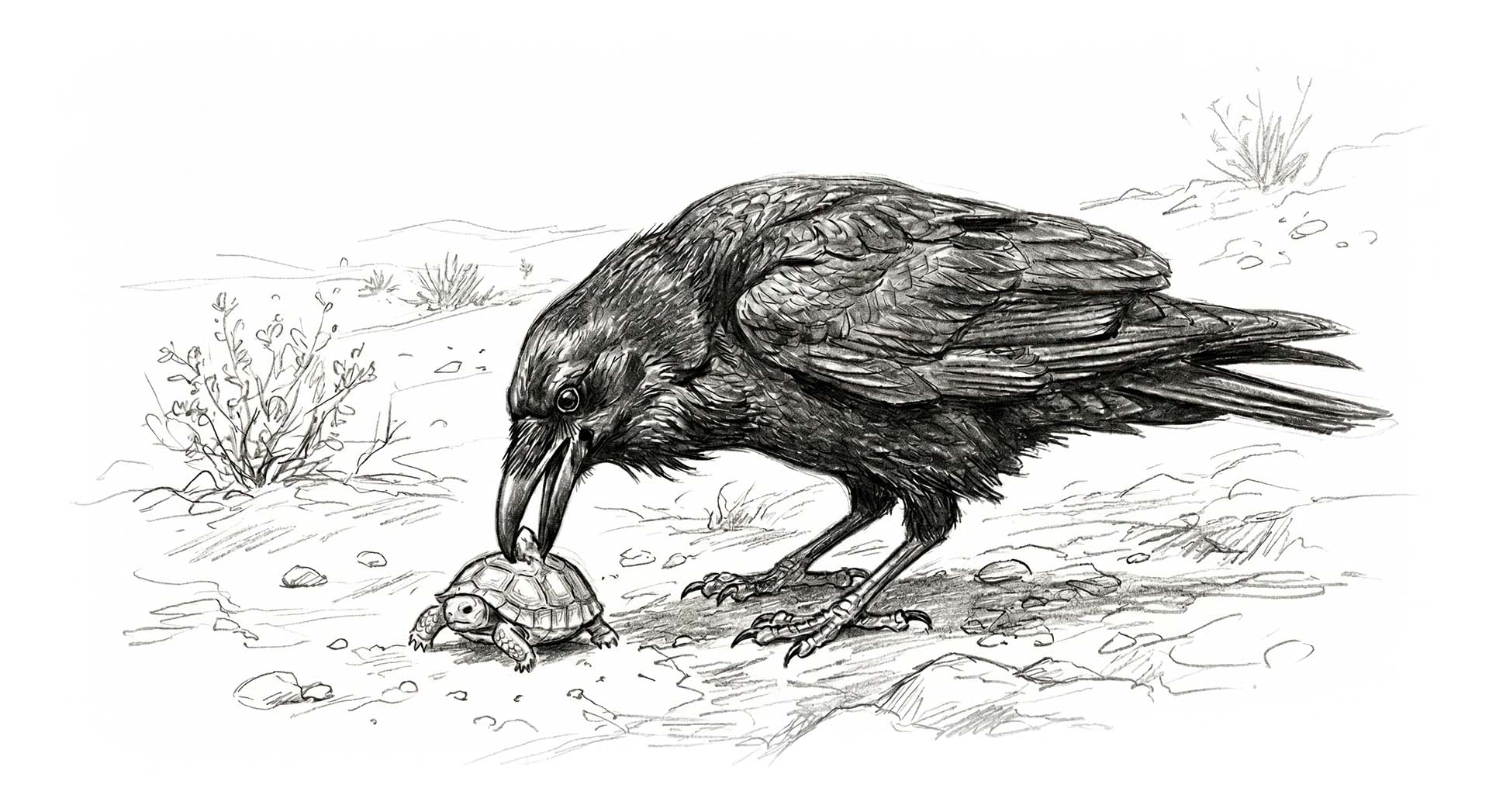
The Real Drivers of Decline
What's Actually Killing Desert Tortoises
The closure remedy targets the smallest cited contributor. Everything actually driving the population collapse remains unaddressed.
The agencies' own records and peer-reviewed literature identify these as the documented drivers of Western Mojave tortoise decline. Route closures affect none of them.
- Drought & climate stress. Named as the leading driver of Western Mojave decline. Allison & McLuckie (2018); BLM 2019 FSEIS Errata at AR 204954.
- Raven predation. Leading killer of juvenile tortoises. Raven populations subsidized by landfills, agriculture, highways, and water infrastructure. Drove a 91% juvenile decline between 2004 and 2014. Court Order at 86, fn. 37.
- Disease (URTD / Mycoplasma agassizii). Upper respiratory tract disease. Continuing population-level threat; endemic in the surviving population. FWS Biological Opinion (2019), FWS 5358–5380.
- Habitat fragmentation. Industrial solar and wind development under the DRECP. About 48,600 acres of Western Mojave habitat lost conservation rating between 2010 and 2017. Parker et al. (2018); BiOp FWS 5390.
- Paved road mortality. Up to 10 tortoises killed annually on paved roads inside Mojave National Preserve alone — more than the entire WEMO OHV network. BiOp FWS 5380.
- Invasive non-native grasses and altered fire regimes
- Livestock impacts
- Illegal collection, dog access, illegal dumping
The official U.S. Fish and Wildlife Service estimate: 8 OHV-related deaths per year across 3.1 million acres. That equals about 0.4% of the roughly 1,800 tortoises lost annually in the Western Mojave Recovery Unit, and about 0.07% of the population. The only cause route closures actually address. Court Order at 9, 30, 85–87; FWS BiOp 5405–5406.
The 1994 Recovery Plan set 3.9 adult tortoises per square kilometer as the minimum density "recommended to avoid extinction." The 2014 density in the Western Mojave Recovery Unit was 2.8 per square kilometer. Adult density had already fallen below the federal recovery plan's own extinction-avoidance threshold by 2014, while drought, raven predation, and disease — the documented drivers — continued unaddressed.
The 2019 Biological Opinion lists eight categories of OHV-related impact: vehicle strikes, habitat occupation, introduction of invasive non-native plants, altered fire cycles, attraction of subsidized predators including ravens, dog access, illegal dumping access, and habitat fragmentation. Of the eight, only the first — direct vehicle strikes — is reduced by closing a route. And as established above, the FWS's own estimate puts OHV mortality at 0.4% of annual loss. Route closures do not address the other 99.6%.
Sources
BLM 2019 Errata to the Final Supplemental Environmental Impact Statement, adopting Allison & McLuckie (2018). AR 204954.
U.S. Fish and Wildlife Service. (2019). Biological Opinion for the West Mojave Route Network Project. FWS Administrative Record 5358-5380, 5361, 5370, 5390, 5405-5406.
Center for Biological Diversity v. Culver, Case No. 3:21-cv-07171-SI, Order on Cross-Motions for Summary Judgment at 84-90, footnote 36, footnote 40 (N.D. Cal. Oct. 22, 2024).
23 Years of Closures, Zero Improvement
OHV-Route Closure Strategy Has Already Been Tested. It Failed.
The population data from the court record tells the final story. The adult population in the Western Mojave Recovery Unit dropped from 35,777 in 2004 to 17,644 in 2014. This 50% decline occurred while thousands of miles of routes were already closed or restricted under successive management plans.
FWS projected the decline would continue, with the population falling to approximately 8,700 by 2024. A 23-year monitoring program showed "no substantial positive effect" from management actions.
If route closures were going to recover the tortoise, the data from the past two decades of closures should already show it. It does not.
Sources
BLM Final Supplemental Environmental Impact Statement. AR 103505.
U.S. Fish and Wildlife Service. (2019). Biological Opinion for the West Mojave Route Network Project. FWS Administrative Record 5405-5406.
Center for Biological Diversity v. Culver, Case No. 3:21-cv-07171-SI, Order on Cross-Motions for Summary Judgment at 30, 85 (Table 7), 88, footnote 40 (N.D. Cal. Oct. 22, 2024).

The Selective Standard
What the Same Agency Approved on the Same Land: Industrial-Scale Renewable Energy
While the federal government was proposing to limit OHV access to protect the desert tortoise habitat, every level of government — federal, state, and county — was approving industrial-scale renewable energy projects across the same Western Mojave landscape. The closure remedy targeted only routes used by off-road recreation. It did not touch the energy development happening alongside it.
In 2016, the Bureau of Land Management — the same agency that managed the WEMO route designations — finalized the Desert Renewable Energy Conservation Plan, or DRECP. The DRECP is a master land-use plan covering 22.5 million acres of Southern California desert.
The DRECP's stated purpose, in the agency's own words, was to provide "a streamlined process for the development of renewable energy." In plain language: faster permits, fewer hurdles, for utility-scale solar and wind. Inside the DRECP, BLM designated 388,000 acres of public land as "Development Focus Areas" — land set aside specifically to be built on with energy facilities. That is roughly 600 square miles, an area about the size of the city of Los Angeles, designated for development in the same desert where the same agency was also closing dirt trails to protect the tortoise.
Read the highlighted row carefully. Individual approved or proposed energy projects inside the WEMO planning area occupy a contiguous footprint that rivals or exceeds the entire 5,997-mile motorized route network — concentrated in single blocks of removed habitat rather than dispersed across 3.1 million acres. North Sky River Wind alone covers 13,535 acres. Bellefield Solar's planned footprint is 8,371 acres. Pacific Wind covers 8,000 acres. Discovery Solar's permit footprint is 7,700 acres. Each one of those, individually, equals or exceeds the entire route network the agency claims is too damaging to tortoise habitat to leave open.
A peer-reviewed 2018 study in PLOS One (Parker et al.) measured how much Western Mojave habitat had been altered by solar and wind facilities between 2010 and 2017. Of 76 one-square-mile units that lost their conservation rating during that period, 14 had previously been rated "Ecologically Core" — the study's top conservation tier, meaning land that was largely undisturbed and identified as critical for the desert's most sensitive species, including the desert tortoise. Their rating dropped because they became close enough to industrial-scale development to lose their connectivity to other intact habitat.
Tortoises can cross a dirt road. But once carved up by industrial uses, habitat completely stops functioning for a species that depend on continuous range.
The point is structural. Habitat fragmentation is one of the eight OHV-related impacts FWS itself listed to justify the closures. Solar and wind facilities fragment tortoise habitat at a far larger scale per project than any dirt trail. The same agency, in the same time period, on the same federal lands, applied a tortoise-protection standard that closed routes for OHV use while running a streamlined permitting program for energy development. Whatever your view of either policy, a tortoise rationale cannot be applied selectively against a fraction-of-a-percent mortality source while a far larger fragmentation source proceeds under a different stamp. And fast-tracked.
Sources
U.S. Bureau of Land Management. (2016). Desert Renewable Energy Conservation Plan, Land Use Plan Amendment, Record of Decision. AR 34904-35013.
Parker, S. S., Cohen, B. S., & Moore, J. (2018). Impact of solar and wind development on conservation values in the Mojave Desert. PLOS ONE, 13(12), e0207678. https://doi.org/10.1371/journal.pone.0207678
U.S. Fish and Wildlife Service. (2019). Biological Opinion for the West Mojave Route Network Project. FWS Administrative Record 5390.
Center for Biological Diversity v. Culver, Case No. 3:21-cv-07171-SI, Order on Cross-Motions for Summary Judgment at 11, footnote 5; 86 (N.D. Cal. Oct. 22, 2024).
The Real Crisis Is the Next Generation
Lawsuits Over Dirt Trails Are Wasting What Time Is Left.
Between 2004 and 2014, the proportion of juvenile tortoises in the Western Mojave declined by 91%. That is a real crisis. It is also the part of the population that determines whether the species survives at all.
Adult tortoises can live 50 to 80 years. Without juvenile recruitment to replace them, the existing adults age out and the population continues toward collapse regardless of what happens to dirt trails. The primary predator of juvenile tortoises is the common raven, whose populations have exploded under subsidies from human development: landfills, agriculture, and energy and water infrastructure.
Ravens do not distinguish between tortoises near open trails and tortoises near closed trails. Fences do not matter. They hunt from the air. A juvenile tortoise whose shell has not yet ossified is equally vulnerable whether the nearest route is designated open, closed, or never existed. The 700% (+1,500% by other estimates) raven population increase documented by USFWS is driven by human infrastructure that no route closure addresses. Landfills, transmission towers, energy developments and agricultural operations will remain in place regardless of how many trails are removed from the network.
The fix is not closing trails. It is addressing the other 99.6% of mortality causes, which may include controlling predator populations, capping subsidized food sources, and protecting nest sites where juvenile tortoises are most vulnerable. It requires resources, focus, and agency capacity. None of that is available while BLM is tied up in court.
For nearly two decades, anti-access litigation over WEMO route designations has diverted BLM and FWS resources— most recently through the Center for Biological Diversity's 2021 lawsuit that produced the 2024 closure remedy targeting OHV access responsible for roughly 0.4% of annual tortoise mortality. The same dollars, the same agency staff, and the same calendar could have been spent on the 99.6% of mortality that actually drives the decline.
−91%
Decline in proportion of juvenile tortoises in the Western Mojave, 2004–2014.
50–80 yr
Lifespan of adult tortoises. Without recruitment, the population ages out.
#1
Common ravens are the leading predator of juveniles. Sustained by human infrastructure, not dirt trails.
~20 yrs
How long anti-access org have diverted BLM resources via lawsuits to attack OHV.
Sources
Allison, L. J., & McLuckie, A. M. (2018). Population trends in Mojave desert tortoises (Gopherus agassizii). Herpetological Conservation and Biology, 13(2), 433-452. AR 204954.
Center for Biological Diversity v. Culver, Case No. 3:21-cv-07171-SI, Order on Cross-Motions for Summary Judgment at 86, footnote 37 (N.D. Cal. Oct. 22, 2024).
Bottom Line
Closing trails to address a fraction-of-a-percent mortality factor while ignoring the threats causing a 50% population collapse is not conservation.
The desert tortoise deserves real science targeted at the things actually killing it. Off-roaders deserve an honest accounting of why their access is being taken away. Right now, neither is getting one.
What This Means for OHV Access
The Tortoise Is the Excuse. Closure Is the Goal.
BlueRibbon Coalition has never argued that the desert tortoise does not deserve help. It does. But efforts to recover tortoises must be based on science, not convenience or speculation.
Closing dirt trails is as easy as it is unpopular and ineffective. Addressing raven overpopulation, disease, and drought is hard. The court chose easy, and the litigation produced a closure remedy aimed at the only user group whose activity is documented as a fraction-of-a-percent contributor to mortality.
The Estimate
OHV mortality is 0.07% of the population
FWS estimates 8 OHV-related tortoise deaths per year across 3.1 million acres. Paved highways in a single preserve kill more.
The Math
Even 20x that estimate is under 9%
Multiply the government's number by an unreasonable twenty. OHV use still cannot mathematically explain the population collapse. The other 91%-plus comes from drought, ravens, and disease.
The Proof
Fences couldn't save them
A population fully fenced off from vehicles for 24 years lost 92% of its tortoises to disease and predation. Route closures are not even fences.
The Track Record
23 years of closures, zero improvement
The agencies' own monitoring program produced "no substantial positive effect" while the closure footprint expanded and the tortoise population fell by half.
As a result, public support for the Endangered Species Act is justifiably eroding among the group of Americans targeted by these actions that the records show will make no difference.
TAKE ACTION
Real Conservation Demands Real Science
The tortoise deserves protection from the actual threats. Off-roaders deserve an honest accounting.
BACK TO
Part 3: The Insider
NEXT UP
Take Action
It's Time For a New Playbook.
BlueRibbon Coalition isn't standing idly by. We're fighting to change the rules that make cooperating in the current system a losing endeavor. Join us.