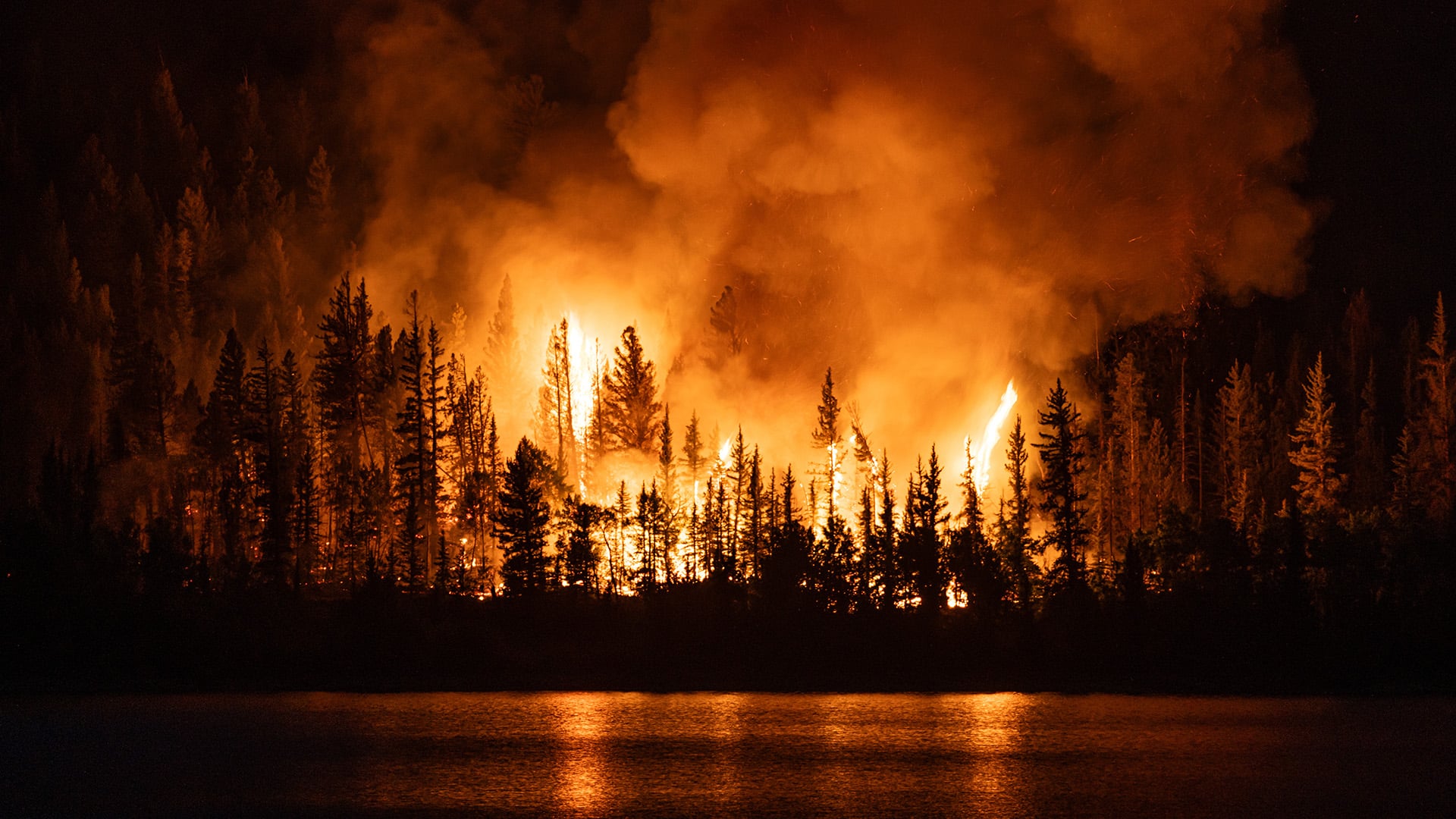
Every fire season the West watches the same terrible rerun. Foresters and local collaboratives spend years identifying a landscape primed to burn and designing the treatment to blunt it. The plan clears review, and then the part that matters does not get done. It is litigated, whittled down, or left on a shelf until the fire everyone saw coming arrives and does to the forest what no timber sale ever could. The Grasshopper Fire burning on Oregon's Mt. Hood National Forest is that sequence in its purest form, and it is a clear example of an opportunistic anti-management organization using lawfare to destroy the forests it claims to defend.
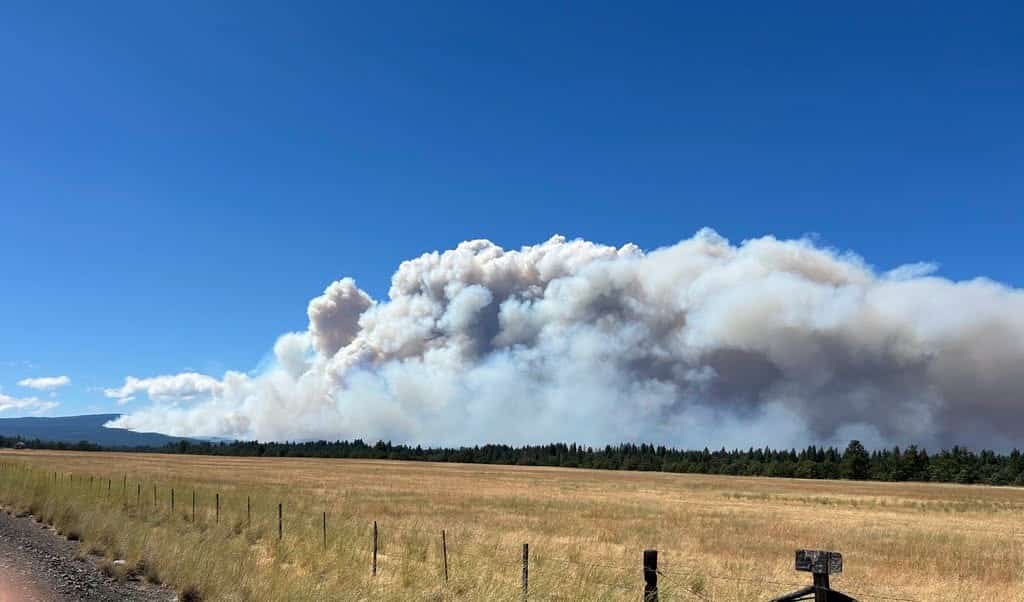
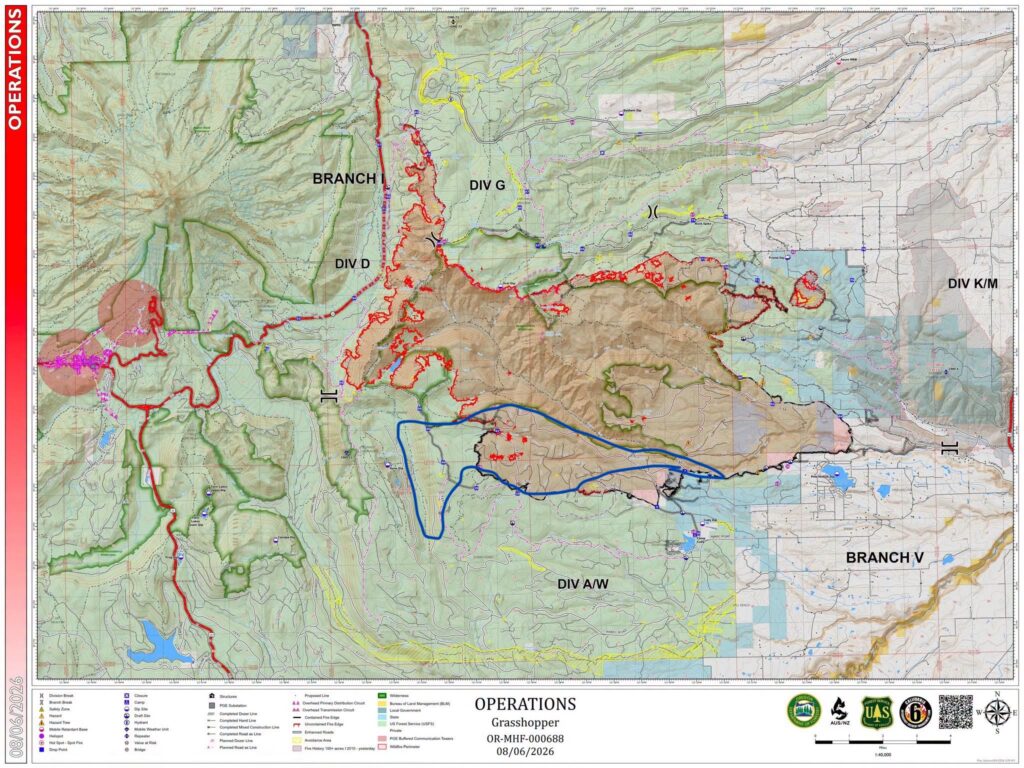
The fire has burned more than 83,000 acres. It is 20 percent contained, a number that has moved lower since August 6 while the fire added roughly 30,000 acres. It has cost taxpayers $33.1 million so far. It has closed Highway 35 from the Highway 26 junction to Hood River, severing the Mt. Hood loop. It has forced the evacuation and closure of Mt. Hood Meadows, put Government Camp and Timberline Lodge on notice, driven Level 3 "Go Now" orders across rural Wasco County, and pushed the Oregon Air National Guard to deploy 44 airmen as hand crews, the first time in its history it has put personnel on the ground to fight fire. It destroyed the Flag Point Lookout, a site that had watched this forest for a century.
It burned through the landscape the Grasshopper Restoration Project was designed to treat. That project was a wildfire mitigation treatment local collaborators helped design. Oregon Wild sued over it in 2023. The commercial thinning at its center was pared back in settlement, and it has never been carried out. And sixteen days before this fire started, Oregon Wild and WildEarth Guardians served notice to sue over four more east-side projects, using the same instrument, the threatened northern spotted owl, to stop them.
The facts we can all agree on
Oregon Wild challenged Grasshopper in 2023 under NEPA and settled in January 2025: the Forest Service dropped two old-growth units, agreed to diameter limits and reduced treatment intensity on the rest, and paid Oregon Wild $55,000 in attorney fees under the Equal Access to Justice Act. Eighteen months later, by Oregon Wild's own telling, the agency still had not laid out a single timber sale. On this much everyone agrees. The treatment was narrowed, then it stalled.
Oregon Wild's defense is that the stall is not its fault: it never sought an injunction, so nothing forced the delay but the agency itself. But as we’ll discuss below, that’s not entirely accurate and it changes nothing about what came next.
What the Forest Service said would happen
The agency wrote down what these treatments were for, three years before the lightning strike. From the Grasshopper environmental assessment: both action alternatives "would reduce the extent and severity of wildland fires" and "would create defensible space and areas of safe engagement for fire suppression personnel along Forest Service roads." From the signed decision notice: "Treatments that would reduce flame lengths and slow down fire behavior would allow for fire suppression activities to take place, and would also increase the likelihood of successful suppression." And: "Across the eastern areas, thinning and prescribed fire would reduce burn severity if a large fire occurred."
The agency also answered Oregon Wild's central scientific argument before Oregon Wild made it. Oregon Wild's position is that thinning creates hotter, drier, windier conditions on the forest floor. The Forest Service considered exactly that and rejected it in the decision document: "Surface winds may increase, and fuel moistures may decrease due to proposed treatments. However, overall reduction in expected fire behavior and fire severity would outweigh any changes in fire weather factors due to thinning."
Defensible space along Forest Service roads. Safe engagement for suppression crews. Reduced burn severity across the eastern areas. That was the plan. Crews are now cutting line by hand in beetle-killed timber on slopes too steep for equipment, and containment has gone backwards.
This is about a pattern not a project
On July 7, 2026, Oregon Wild and WildEarth Guardians served a sixty-day notice of intent to sue over the Gate, 27 Road, Gibson, and Hootnanny Projects, which combined totaled 11,765 acres of thinning and fuel-break work on Mt. Hood's east side. They claim that the Forest Service failed to consult adequately over the projects' effect on the threatened spotted owl as required by the byzantine requirements of the Endangered Species Act. And unlike at Grasshopper, this time these anti-management groups were explicit that they wanted the work stopped. Their notice warns that any implementation before consultation is complete "will further violate ESA Section 7, risk violation of ESA Section 9, harm and potentially jeopardize a threatened species, and warrant emergency injunctive relief."
Three of those four projects are named for insects and disease. The Grasshopper fire has run primarily through beetle-killed timber. The projects they noticed for suit are aimed at the precise fuel condition that carried this fire across 77,000 acres.
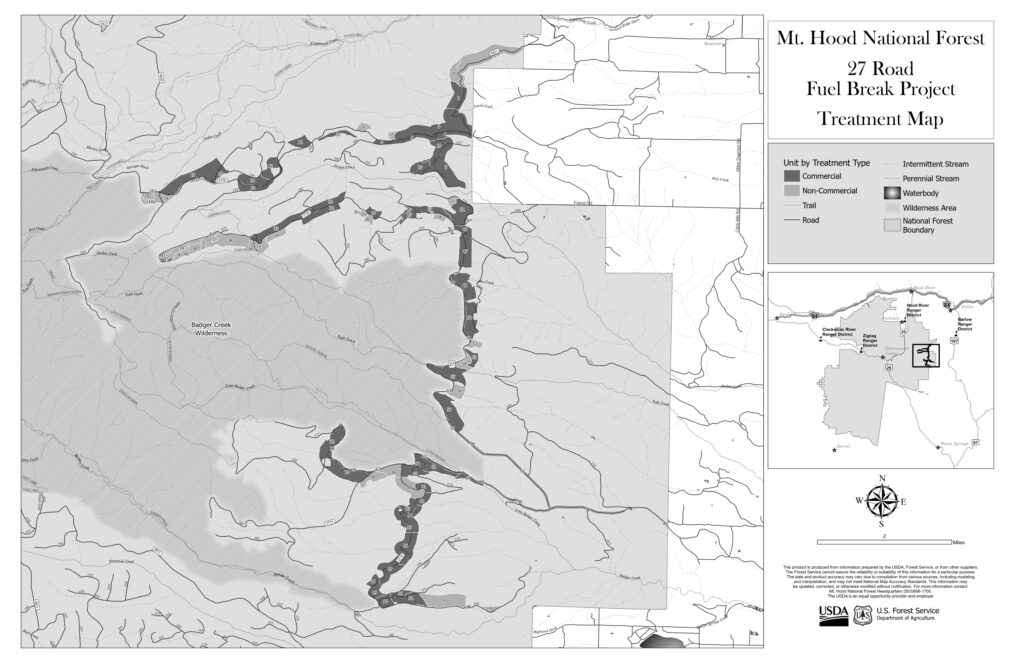
One of the four projects was, the 27 Road Fuel Break, was proposed to hold a line against a large fire on this exact landscape, and the Forest Service said this would help keep owl habitat standing through a blaze. In a footnote, the anti-management groups brushed that rationale aside as "of little relevance," reasoning the thinning would set back owl habitat regardless. They filed that sentence sixteen days before a fire destroyed owl habitat here by the tens-of-thousands of acres. A fuel break's worth is measured against the fire that comes not the minor disturbance corridor itself creates. The fire came. And now emergency dozer lines have been constructed along more mileage than ever would have been affected by the fuel break and across a larger footprint than the project area. And as of this writing the fire has burned over many of the dozer lines, so the accumulation of impact isn't close to complete.
This threatened lawsuit reaches past these four projects: the anti-management position argues the Forest Service may no longer lean on the programmatic consultations it uses to approve fuels work at scale, and must instead consult project by project on the owl by citing a 2026 ruling resulting from a lawsuit from Center for Biological Diversity that any project-level habitat effect counts. Accept it, and the fastest lawful path to treating owl-country forest closes. That is where the owl stops being the thing protected and becomes the thing used to stop the very work meant to keep its forest from burning. This is a rigged game that only the wildfire can win, because it is the one landscape altering force that doesn't have to consult with anybody. And to be clear it was the attorneys at Oregon Wild, Wildearth Guardians, and Center for Biological Diversity who spent decades rigging the system for wildfire to destroy our forests, including the endangered species habitat they claim to care so much about.
How lawfare actually works
Litigation of this kind does not always work by winning. This is lawfare, and the goal of lawfare is to wear down an opponent with high costs, bad publicity, and wasted time rather than just winning a court case. An agency that is sued, settles, writes a check, and swallows new restrictions learns that every project it proposes is a liability waiting to be named in a complaint, and it starts to discipline itself. It pads the record instead of moving dirt, drops the units most likely to draw a challenge, and slows to the pace of its own legal fear.
The Grasshopper record shows it. The project suffered a two year delay right out of the gate that was a consequence of Oregon Wild's lawsuit. Oregon Wild can claim that with no injunction there was no court-ordered delay. This is technically true, but, without the litigation pressure, the project would have likely proceeded years ago. Eighteen months after settlement, the agency had not finished even the pre-sale layout and told Oregon Wild it was not ready. That is not an agency that lost a case. It is an agency taught, case after case, to flinch, wait, and not take a risk; and this worth more to Oregon Wild than any single injunction, because it kills the projects that are never even filed.
The same district already has the proof. The Crystal Clear Restoration Project covered 11,742 acres on the Barlow Ranger District, written to "reduce the risk of high-intensity wildfires" and "promote safe fire suppression activities." Oregon Wild was a plaintiff. The Ninth Circuit ruled in 2020 that the Forest Service should have written a full environmental impact statement. The project was canceled. It was never re-proposed. Nearly 12,000 acres of wildfire risk reduction on this same district, erased six years ago, with nothing built in its place.
Lawfare keeps projects on the shelf, agency staff in their cubicles, and fuel loads growing.
The staffing excuse
Oregon Wild also wants us to know they're not to blame because of the USFS staffing cuts. They called it mass layoffs of nearly 6,000 people. Chief Tom Schultz tells it differently, and the agency's own personnel data backs him: most of last year's departures were voluntary buyouts, not layoffs, and the Forest Service has since added more than 1,600 employees. Total staffing now sits at roughly where it was in 2018.
Oregon Wild offers its version anyway, hedged as something that merely might have delayed the project, and raises the agency's weakness not as an alarm but as an excuse. The untreated forest is not, to them, a problem to solve; it is the objective. Whether the acres go unthinned because the staff is gone or because the process never ends, the fuel load is identical. If no one is left to write the environmental analysis, there is no project to sue. Their extractive litigation business model requires completed plans in order for them to sue, settle, and collect from the U.S. taxpayers. They don't want staff to actually get on the ground and remove vegetation. They just need the army of staff their serial litigation requires to complete the paper work to give them legal standing. Even if a single staffing reduction had never happened, Oregon Wild's attorneys were there to ensure fuel load reduction definitely didn't happen.
Where the fire ran hardest
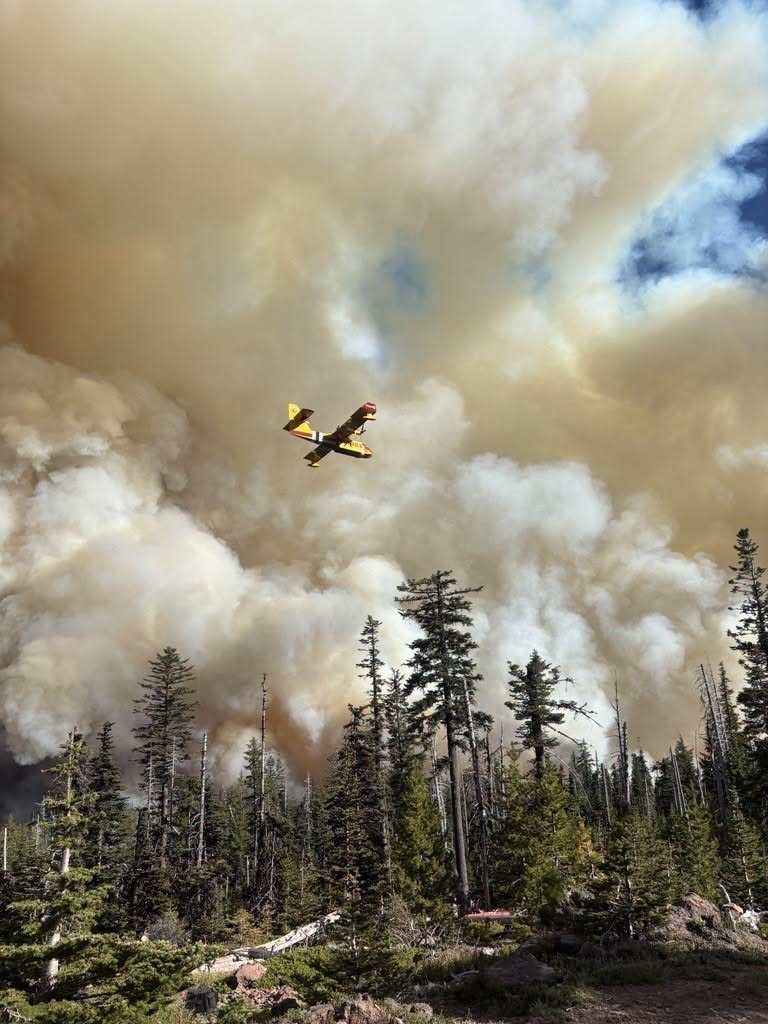
While the stalled projects might have helped if they could have been completed, Grasshopper burned most fiercely inside the Badger Creek Wilderness, where fire officials reported terrain too steep for crews to work and heavy fuels driving the most extreme behavior on the incident. Badger Creek is designated Wilderness, and it is ground where the law forecloses the mechanical thinning that might have moderated what is now burning. The place set aside to be left untouched became the place the fire ran hardest and no one could safely defend: a fuel load that is a function of law, not neglect.
The 27 Road Fuel Break was engineered to sit against the wilderness boundary precisely because the core itself cannot be treated. Oregon Wild noticed this wilderness protection project for suit on July 7. The proposed fuel break lines are mostly now inside the fire, unbuilt. And, as of the time of this writing, nearly all of the Badger Creek Wilderness, including all of its precious spotted owl habitat, is located within the burn perimeter.
The Grasshopper fire makes it clear that a congressional Wilderness designation is nothing more than a death sentence for the ecosystems that exists there. We should reconsider this failed experiment in non-management while there are still a few wilderness areas left that aren't apocalyptic burn scars.
The species they came to court to protect
Oregon Wild's defense collapses hardest against their own stated purpose. Their complaint asked the court to protect stands eighty years and older, in its own words, the forest "that provides northern spotted owl habitat." The threatened owl with its critical habitat covering Wasco County was the named beneficiary of the suit. Against a stand-replacing crown fire, that concern inverts. A diameter-limited thinning takes selected trees and leaves the stand; a high-severity fire takes the stand, the canopy, and the understory all at once. The owl draws no distinction between a nest tree felled under a marking guideline and one cooked to a snag except the fire takes the whole forest with it. Oregon Wild went to court to spare these stands the saw and helped ensure they kept their appointment with the flame.
The access they took with it
There is a second bill, and it lands on everyone who uses this forest.
Mt. Hood National Forest closure order 06-06-01-26-08 took effect on August 4 and runs until December 31, 2026, or until it is updated or rescinded. It closes 20 roads, 50 trails, seven campgrounds and two trailheads. Badger Creek Trail, Lookout Mountain, Boulder Lake, Badger Lake Campground, Bonney Meadows, Polallie: all shut. Highway 35 has been closed since August 7, from the Highway 26 junction to Hood River, which severs the Mt. Hood loop. Mt. Hood Meadows was evacuated and closed on August 4. Alex Rogers, who manages the Huckleberry Inn in Government Camp, told KATU that "last week, we had the entire restaurant filled up around this time, and now it's almost like a ghost town."
The order does not single out motorized users. It closes the burned country to everybody. Twenty roads is the figure that matters to BlueRibbon members, because on this forest the roads are the access, and a road inside a burn scar does not reopen the day the fire is called contained. Hazard trees have to come down first. Culverts and drainage have to be assessed. The reopening happens on the agency's schedule, with the agency's remaining staff.
That is what gets lost when litigation replaces management. Not an abstraction about forest health. The road you take to get up the mountain. The campground you booked in June. The trailhead you paid to park at. Every one of those closures traces back to the same sequence.
What it would take to believe them
Oregon Wild's case rests on the premise that the Forest Service is too broke to act. Take that seriously, and two things follow that Oregon Wild has not done.
An organization that believed the agency was too financially starved to fight fire would not be cashing that $55,000 check to pay their attorneys pulled from that same agency's budget. They should return the funds to the evacuated families of Wasco County and the local relief effort, or any of the organizations they're encouraging others to support instead of criticizing them.
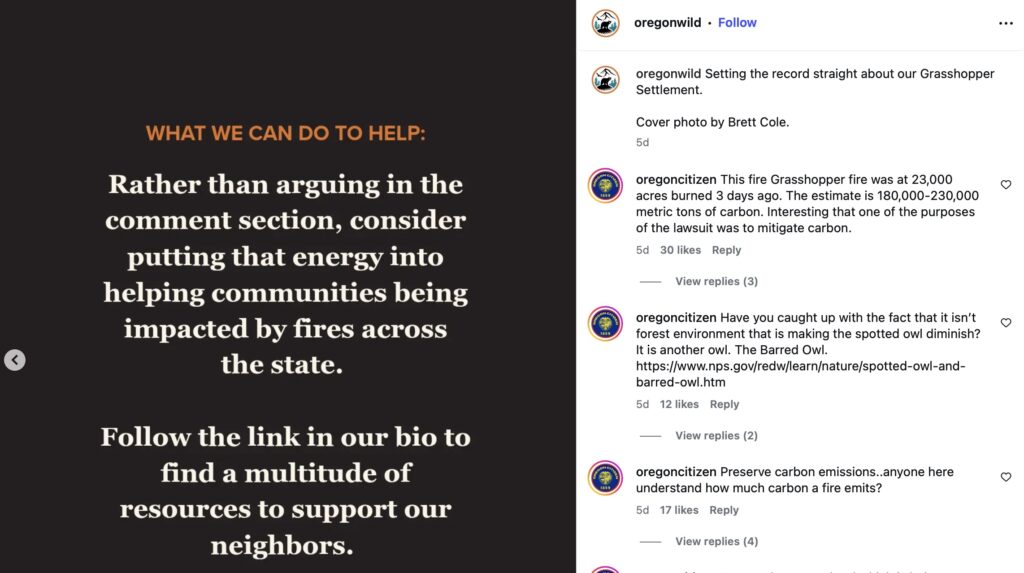
An organization that cared about scarce agency resources wouldn't have moved to spend the agency's scarce capacity in court during peak fire season over four more projects, including the firebreak now burning. They should also withdraw their July 7 notice of intent to sue the agency.
Return the money. Drop the suits. Do both, and maybe this organizations concern for the forest, the owls, and the agency could be considered genuine.
The record we're keeping
Grasshopper is not an aberration. It is one file in a growing ledger of fuels and forest-health projects that foresters designed, communities backed, and process consumed while the acres waited for a spark. That ledger is why the BlueRibbon Coalition built the NEPA Jail, a tracker documenting the treatments stranded between approved and implemented.
The tracker holds 279 projects covering 5.3 million acres of planned treatment. Average time in NEPA before a decision: 4.2 years. Longest: 20 years. Of the acres attached to projects that were killed or narrowed: 3.7 million, 70% of the total. Forest Service attorney fee payouts to litigants from 2000 to 2025: $34.4 million. Oregon Wild appears on 29 of those projects. WildEarth Guardians on 28. The Center for Biological Diversity on 37. Counting each project once, those three organizations turn up on 76 of the 279, better than one in four.
Grasshopper is in it. So are the four newly noticed Mt. Hood projects, filed on the strength of the July 7 notice. The same sequence each time: planned, backed, obstructed, burned.
When litigation overrides the judgment of the foresters and communities who tend these lands, someone pays, and it is not the litigants. The bill is paid by the firefighters cutting line by hand on slopes no dozer can reach. It is paid by the owl whose forest is now snags. It is paid by the communities in Wasco and Hood River counties whose watersheds, businesses and access are gone. It is paid by every family who planned a trip up Highway 35 this summer. And it is paid by every American taxpayer, twice: once for the attorney fees, and again for the suppression bill.
If you appreciate articles like this and our NEPA jail tracker to hold these anti-management organizations accountable, consider making a tax-deductible donation today. It takes a team of people to investigate, research, write, advocate and litigate for our right to protect and access our public lands.
Or purchase something from our webstore!