
In the last week of the Biden Administration, the Bureau of Land Management released the record of decision for the resource management plan (RMP) regarding the 1.87 million acres Grand Staircase-Escalante National Monument (GSENM) in southern Utah. All national monuments are managed by a resource management plan that shows which areas allow for which activities and set the stage for travel management planning. As we have previously covered, monuments are abused to restrict access and lock up land. This land grab is no different. The RMP that was finalized significantly reduced and restricted access and use that historically had always been allowed on these lands.
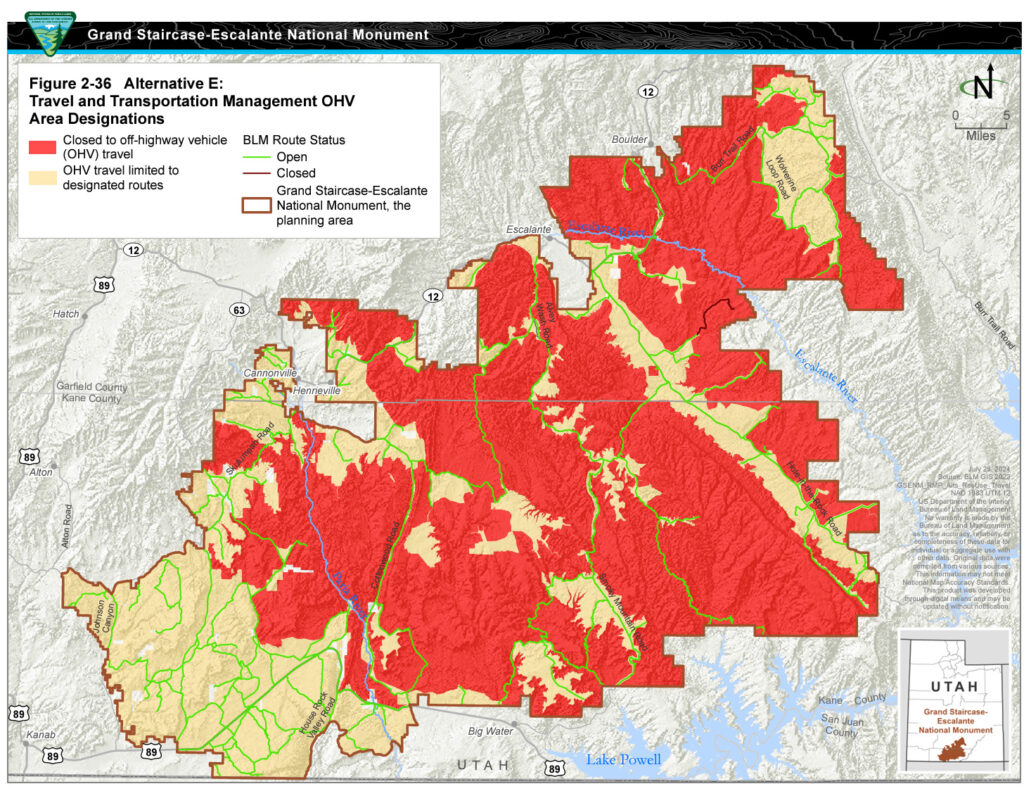
According to this plan, the Monument is divided into four zones that determine their accessibility: Front Country (about 36,000 acres), Passage (roughly 53,000 acres), Outback (approximately 558,000 acres), and Primitive areas, with more than 1.2 million acres classified as Primitive, representing the most restrictive management category. Motorized and mechanized travel is prohibited in Primitive areas, effectively closing over 1.2 million acres to off-highway vehicles and mountain bikes. Dispersed camping is restricted to designated locations and subject to duration limits, and livestock grazing is reduced or limited to trailing in certain areas. Recreational target shooting, and wood gathering is also extremely restricted. The plan also withdraws Monument lands from new mineral and geothermal leasing and designates additional Areas of Critical Environmental Concern. The new resource management plan is not consistent with historical use, local economies, communities and their governments. Despite this, there are still those who insist that Monuments don't restrict recreation.
GSENM lies within Representative Celeste Maloy's Congressional district, and she is proposing using the Congressional Review Act, a tool that allows Congress to overturn recently finalized federal rules, to invalidate this closure management plan. On January 15, 2026 the U.S. Government Accountability Office stated, "the Grand Staircase RMP meets the APA definition of a rule, and no CRA exception applies. Therefore, the Grand Staircase RMP is a rule subject to CRA's submission requirements."
Once the GSENM RMP is submitted for the Congressional Review Act, any Member of Congress may introduce a joint resolution of disapproval specifically targeting the RMP. If both the House and Senate pass the CRA resolution and it is signed by the President, the GSENM RMP would be nullified in its entirety, treated as though it never took effect and it would go back to the 2020 resource management plan. Importantly, the CRA would also prohibit the Bureau of Land Management from issuing a substantially similar management plan for the Monument without explicit authorization from Congress.
This would be an immediate win for recreation and public land access in southern Utah. However, we also think the designation of this monument was an abuse of the Antiquities Act. We are still waiting to hear the 10th Circuit Court of Appeals response to our legal challenge to this abusive monument. We would also support presidential action to rescind or reduce the size of this monument.
Please encourage your members of Congress to support rescinding the Grand Staircase-Escalante National Monument Management Plan.