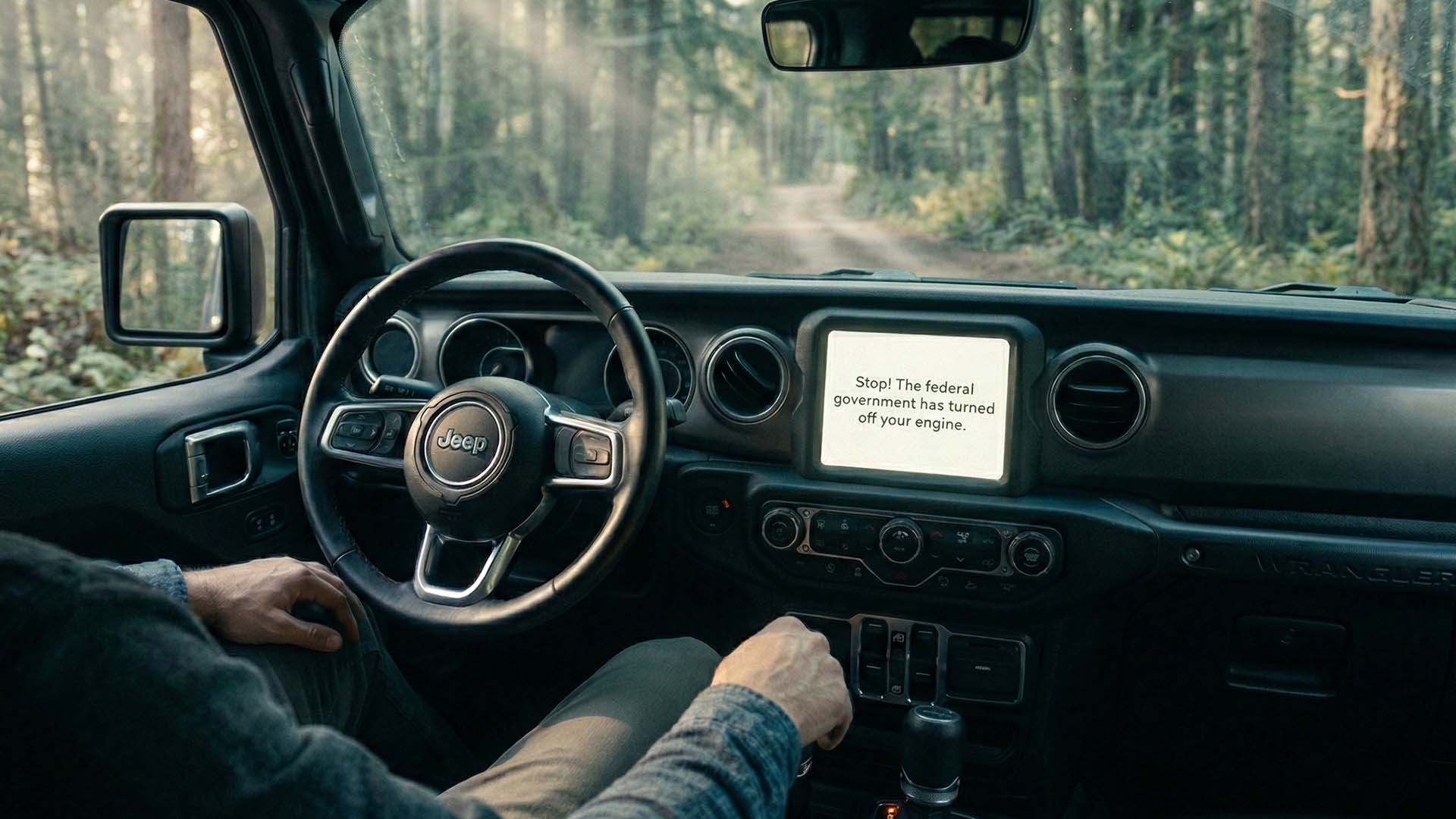
Imagine you’re miles from the nearest paved road, deep in the backcountry. The sun is dropping behind the ridge and the temperature with it. There’s no cell service, no other people, no easy way out. It's just you, your vehicle, and the long way back. You try to start your vehicle, expecting the familiar rumble that means you’re heading home. Instead, nothing. No ignition. No engine turning over. Then you see a dashboard message that your vehicle has been automatically disabled. There's no corrective action you can take. You are at the mercy of a system that has decided, for reasons you can’t see or override, that your vehicle won’t run. In a place where reliability isn’t a luxury but a lifeline, that moment isn’t just inconvenient—it’s dangerous.
In 2021, Congress passed the Infrastructure Investment and Jobs Act (IIJA), a sweeping bill that included a provision directing the federal government to develop “advanced impaired driving technology” for vehicles. The intent was to address drunk driving by requiring systems capable of detecting impairment and preventing a vehicle from operating if a driver is deemed unsafe.
While the goal of improving roadway safety is widely shared, the language of the law raised significant concerns. The provision requires the Department of Transportation to move toward systems that could limit or prevent vehicle operation based on automated detection. Although the term “kill switch” is not explicitly used, the practical effect of such technology could include restricting or disabling a vehicle without driver input.
As these implications became more widely understood, concern grew among drivers, industry experts, and policymakers. Questions emerged about system reliability, cybersecurity risks, and the broader precedent of government-mandated control over personal vehicles. These concerns ultimately led to the introduction of the No Kill Switches in Cars Act (H.R. 1137), which seeked to repeal the portion of the IIJA that mandates development of these systems. However, when this bill was originally introduced it did not pass. Now Representative Chip Roy of Texas, has filed an amendment to defund Section 24220 (the infrastructure law) that would KILL the Kill Switches in cars.
The concern is not theoretical. As vehicles become more dependent on electronic systems, failures are already occurring in ways that affect safety. There have been reports of vehicles failing to unlock electronically, preventing occupants from exiting during emergencies. Newer systems that control physical vehicle functions can also malfunction. For example, automated seat systems and electronic controls in modern vehicles have raised safety concerns when they behave unpredictably or fail to respond as expected and have caused unnecessary fatalities. These incidents highlight the risks of relying entirely on electronic control systems without reliable manual overrides.
Mandating technology that can limit or disable a vehicle introduces new risks. Any system can fail, and when that system controls whether a vehicle can operate, the consequences can be immediate. False positives, sensor errors, or software glitches could leave drivers stranded or create dangerous situations in traffic. Cybersecurity is another major concern, as connected vehicles present potential targets for hacking. A system designed to control a vehicle could be exploited if vulnerabilities are discovered.
These risks are even more serious for the off-road and over-snow vehicle community. Many riders operate in remote areas, often in extreme weather conditions where access to transportation is critical for safety. If a vehicle becomes disabled due to a system error, individuals could be stranded far from help, potentially in life-threatening conditions. In winter environments especially, maintaining the ability to operate a vehicle is not simply a matter of convenience, but of survival.
The snowmobile and off-road communities have a long history of working in good faith with land managers, researchers, and policymakers. These groups regularly contribute to scientific studies, support wildlife monitoring efforts, and comply with seasonal closures and management practices. They have demonstrated a willingness to adapt and collaborate when real impacts are identified. That same standard should apply here. Regulations should be based on demonstrated need and credible evidence, not on speculative risks or unproven assumptions.
The KILL the Kill Switches amendment offers a straightforward solution by removing the federal mandate and allowing these technologies to develop voluntarily, rather than requiring them across all vehicles. This approach preserves innovation while avoiding unnecessary risks.
At its core, this issue is about maintaining control, safety, and common sense. Technologies that can disable vehicles should not be mandated by Congress, especially when their reliability is uncertain and the consequences of failure could be severe. For many Americans, particularly those who rely on vehicles in rural or remote areas, ensuring that a vehicle will function when needed is essential.
Congress should act to adopt this amendment and ensure that vehicle safety policies do not create new dangers in the process of trying to solve existing ones.