
Over the past few weeks, we’ve seen a familiar coordinated push claiming that congressional action on the Grand Staircase–Escalante National Monument (GSENM) management plan would be “undemocratic” and lead to “chaos.” This is the kind of push that usually feels more like these groups trying to brainwash their followers instead of educating and informing them.
As is usually the case: their narrative doesn’t match reality.
Calling Congress “Undemocratic” — But Not the President?
Some of the loudest voices opposing the use of the Congressional Review Act (CRA) argue that Congress stepping in to reverse the Biden Administration’s management plan is undemocratic.
Let’s go back to fifth grade civics for a minute to scrutinize this claim. Under the American Constitution, Congress is by design the most democratic branch of government.
But those same groups have long supported monument designations made through the Antiquities Act—where a single president can lock up millions of acres of land with the stroke of a pen. The President is elected by the Electoral College.
Most actions taken by any branch of government are regularly checked and balanced by the other branches, but not Antiquities Act designations. Courts have historically been deferential to designations, but we believe additional scrutiny is needed. Even though the Constitution clearly gives power to manage federal land clearly to the Congress through the Property Clause, the Antiquities Act assumes this entire Constitutional Power can be delegated away to a single actor in the system: The President of the United States. This Constitutional problem is one of the claims we are making in our challenge to the Chuckwalla National Monument designation, which was made by President Biden after his party had lost the White House in the lame duck period of his presidency when democratic accountability to the people was completely thrown to the wind.
No vote in Congress.
No approval from local communities.
No meaningful input from the people most affected.
So an Antiquities Act designation starts from a place that is arguably unconstitutional, and then the Monument Management Plan is produced through a process that is even more undemocratic. This is a plan that is developed and signed by a cast of agency staff that is four pages long — none of which are democratically elected or face any political accountability to the people. The Administrative State is the most undemocratic institution in our federal government, and they run the show when it comes to things like monument plans.
So when Congress—our elected representatives—uses a lawful process to review an agency decision, suddenly that’s “undemocratic”?
That’s not a serious argument. That’s blind and willful ignorance combined with a double standard.

The Congressional Review Act Is Not Radical — It’s the Law
The Congressional Review Act is not new, and it’s not extreme. It’s a tool created by Congress, signed into law, and used by both parties to ensure accountability in federal rulemaking.
Using the CRA is not “going around the system.” It is the system working exactly as designed.
No, This Would Not Create “Chaos”
You’ve probably seen claims that overturning the 2025 GSENM plan would “destabilize management across millions of acres.” That’s simply not true.
If the 2025 plan is rescinded:
- The monument does not become unmanaged
- The previous BLM Resource Management Plans remain in place
- Land managers continue operating under those plans while future decisions are made
That’s how public land management works across the country. There is no vacuum. There is no chaos.
What’s Being Left Out About the 2025 Plan
Supporters of the plan often say it “protects access” and “allows traditional uses.” That’s not remotely true.
What they don’t say:
- Many of those uses—like camping, hunting, target shooting, and wood gathering—already existed under prior plans. But the new plan severely restricts all of them
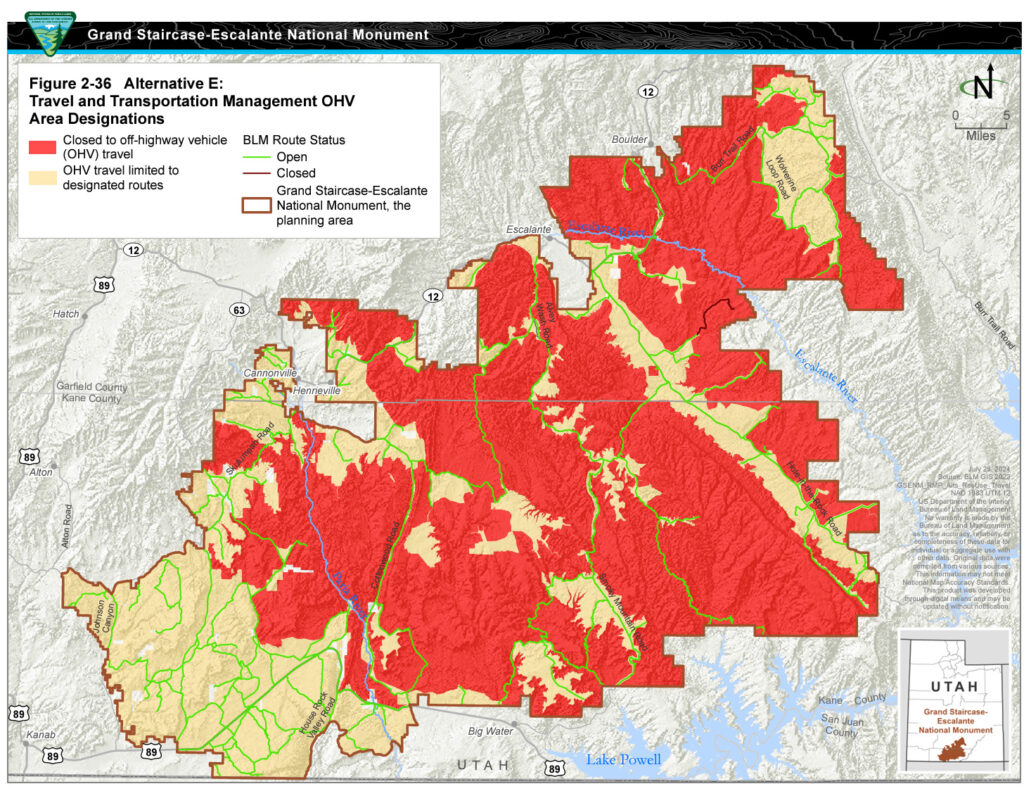
- The 2025 plan introduced new layers of restrictions and zoning
- This plan includes some of the largest restrictions on motorized access that we’ve ever seen, and all the groups opposing this conveniently leave this out.
You can support those changes. That’s a legitimate position.
But pretending nothing changed—or that access was simply “protected”—is misleading, at best.
This Is What the Debate Is Really About
This isn’t about whether GSENM should be protected. It’s about how it should be managed and who gets a say.
Should decisions about millions of acres of public land be locked in by agency rulemaking and executive action? Or should Congress—and by extension, the American people—have a role in reviewing those decisions?
The Bottom Line
The claims that using the CRA is “undemocratic” or would cause “chaos” are not grounded in how the system actually works. They are part of a broader effort to shut down debate and discourage oversight.
At BlueRibbon Coalition, we believe public lands should be managed through transparent processes, with accountability, and with real input from the people who use and care about those lands.
Congressional review isn’t a threat to that principle. It’s a safeguard rooted in democracy.
Take Action
The 2025 Grand Staircase-Escalante management plan is one of the most restrictive in BRC's history, and Congress has the authority to reverse it. Contact your representatives now and tell them to support the Congressional Review Act resolution overturning this plan. Two seconds of your time could help protect access to this incredible landscape.